What Tai Chi can teach us about sleeping?
We spend approximately a third of our lives sleeping, or trying to get to sleep, a problem I see a lot on various wellbeing pages is a lack of ability to get a good night’s rest.
Here is a simple tip that works for me and my students.
One of the martial arts I teach is Tai Chi, while studying under my teacher he mentioned that in
Chen Man-ch’ing’s 13 chapters there is a couple of lines about how to lie down to sleep. I have been doing this for years now and I never fail to fall into a deep restful sleep when doing this.
We often focus on the right mattress or pillow, but perhaps we should focus on something more simple, how we allow our bodies to rest.
One of the central teachings associated with Chen Man-ch’ing, the renowned Tai Chi master, was the importance of relaxation, softness and releasing unnecessary muscular tension.
1. The importance of relaxation
In Tai Chi, relaxation is much more than simply doing nothing. It involves releasing unnecessary tension throughout the body while maintaining a natural, balanced structure. We often carry tension without realising it.
When we go to bed, these habits don’t necessarily disappear. A good sleeping position should encourage the body to settle, allowing the muscles to relax without forcing the joints or spine into uncomfortable positions.
The aim is not to hold a rigid posture throughout the night. It is to create conditions in which the body can relax naturally.
2. The side-sleeping position
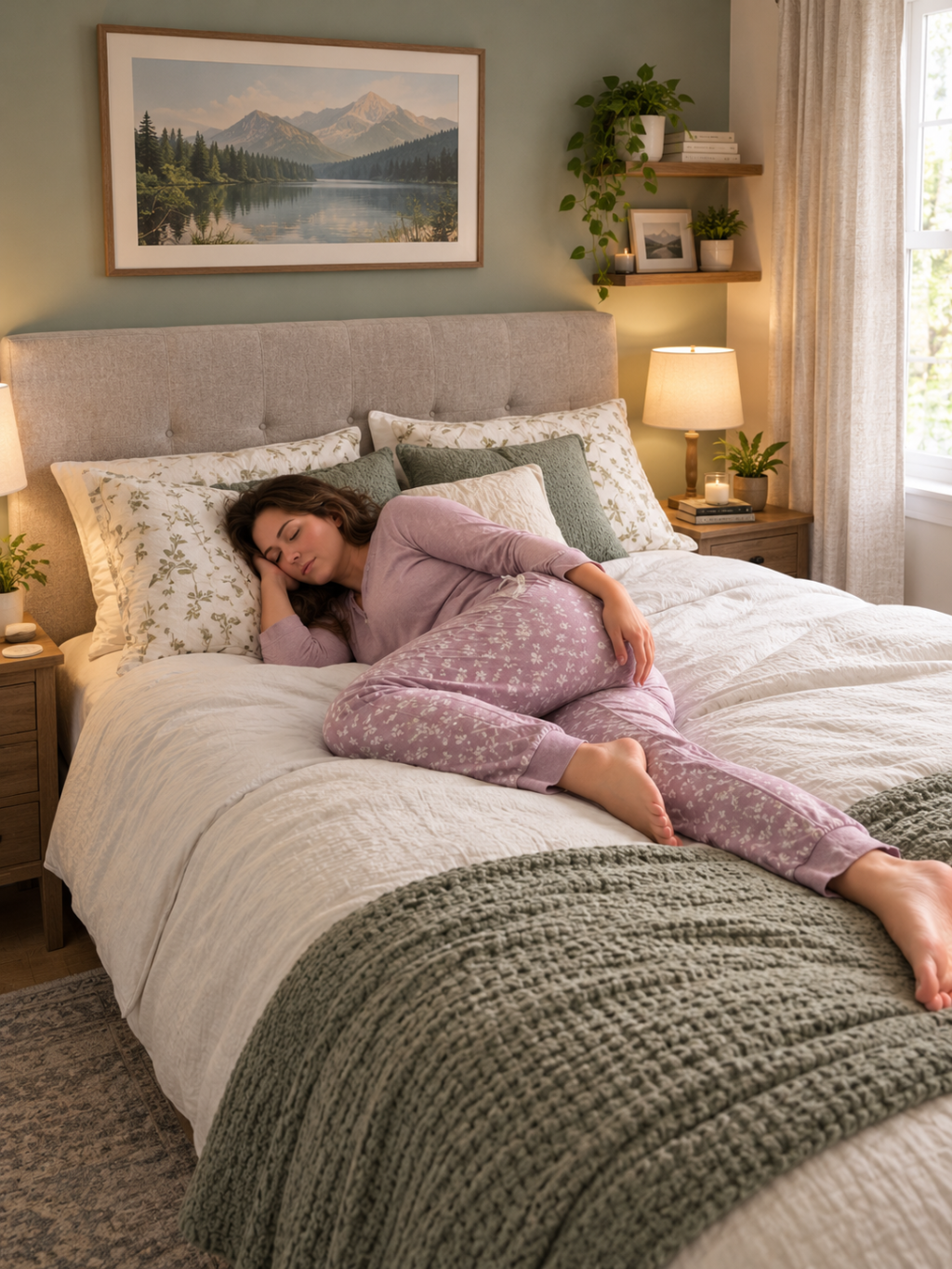
The photograph accompanying this article illustrates a relaxed side-lying sleeping position.
- The body is resting on its right side, with the head supported by a pillow
- The right arm is relaxed with the hand under the head
- The left hanging over the body.
- The right leg is straight, the left bent with the bottom of the foot touching the right leg just below the knee.
This resembles a gentle curled position, sometimes associated with the foetal sleeping position and strangely similar to the recovery position in first aid.
3. Why might this be beneficial?
- Spinal support, sleeping on your side, with suitable pillow support, helps maintain alignment of the spine. Drawing the knee up helps keep the pelvis and hips aligned reducing strain on the lower back.
- Reduced pressure on the airway, sleeping on your side helps open the airways and reduces pressure on the lungs, this position can also reduce snoring and positional obstructive sleep apnoea.
- Comfort and relaxation, this sleeping position is comfortable as it allows the body to settle into a supported position. When the head, shoulders, hips and legs are properly supported, there is less need to maintain muscular tension to feel comfortable.
Cheng Man-ch’ing’s teachings place considerable importance on softness, relaxation and the coordinated movement of the whole body.
One of the lessons we can take from his approach is that unnecessary muscular effort should be released.
We can apply a similar idea when preparing for sleep.
Rather than forcing ourselves into a particular position, we should look for a natural posture that allows the body to settle.
When you sleep your posture should:
- Allow your shoulders to drop and relax.
- Release tension in your jaw and neck.
- Let your breathing become natural and unforced.
- Avoid excessive twisting through your hips and lower back.
- Allow your legs to rest comfortably rather than holding them rigidly.
This is where the philosophy of Tai Chi and the practice of preparing for sleep have something meaningful in common.
Here are some practical suggestions.
Step 1: Support your head
Choose a pillow that fills the space between your head and shoulder. Your neck should remain reasonably straight, in line with your spine, rather than being pushed upwards or allowed to drop downwards.
Step 2: Relax your upper body
Allow your shoulders to settle naturally. Keep your arms comfortable and avoid placing your full body weight on an arm or shoulder in a way that causes numbness or discomfort.
Step 3: Position your legs
Bend your knees slightly, rather than pulling them tightly towards your chest.
Step 4: Allow your body to settle
Once comfortable, take a few gentle, natural breaths. Notice whether you are holding tension anywhere in your body. Allow your muscles to soften without deliberately forcing them to relax.
You should feel supported rather than stretched or twisted.
Does it matter which side you sleep on?
In the 13 chapters the right side is mentioned, but I have found you can sleep on either side, I am aware that for me that sleeping on the right side does tend to give me a more restful nights sleep.
However, it is often recommended during pregnancy that you sleep on the left side and this may also be helpful for some people experiencing acid reflux.